
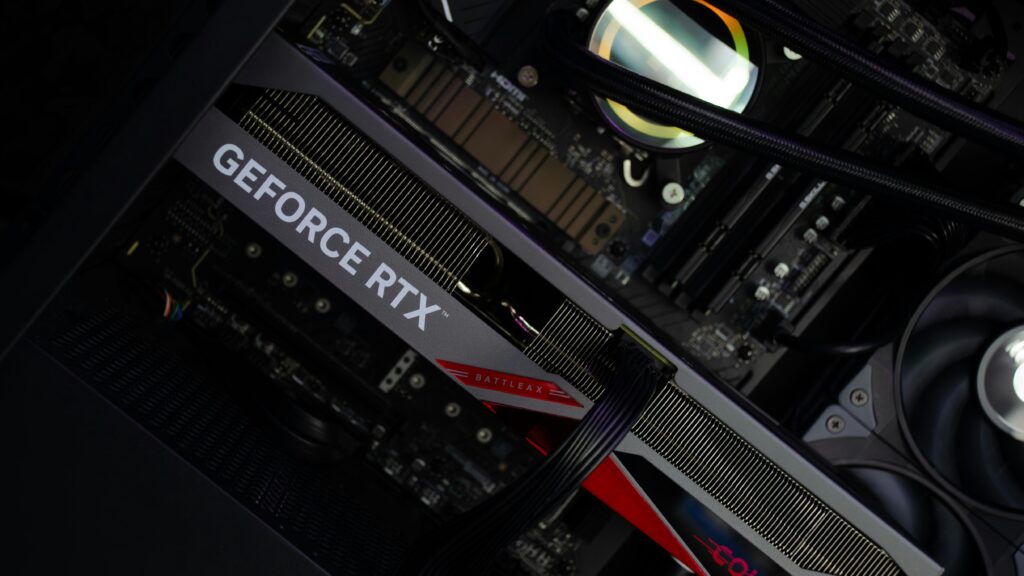
NVIDIA made a groundbreaking announcement at its annual GTC conference on March 18, 2024, revealing the Blackwell architecture, succeeding the highly successful Hopper architecture. This new platform is touted as the world’s most powerful chip for driving a new era of computing. At its core is the GB200 Superchip, which integrates two Blackwell GPUs and a Grace CPU, creating a formidable computing unit.
The Blackwell architecture introduces several pivotal innovations. Key among them is the second-generation Transformer Engine, which dramatically accelerates AI training and inference. Furthermore, it features a new NVLink switch, enabling seamless communication between up to 576 GPUs, scaling performance for the most demanding workloads imaginable. NVIDIA claims an astounding 20 petaflops of FP4 AI performance from a single GB200 Superchip, a leap that promises to unlock capabilities previously considered theoretical.
The Data and Research Behind Blackwell’s Might
Official statements from NVIDIA CEO Jensen Huang highlight Blackwell’s incredible efficiency and power. According to NVIDIA’s specifications, the GB200 Superchip boasts 208 billion transistors, making it one of the most complex chips ever created. The architecture is engineered with fifth-generation NVLink, providing 1.8 terabytes per second of bidirectional throughput per GPU, essential for linking multiple GPUs together at scale. This unprecedented interconnectivity ensures that data flow is not a bottleneck, even in massive deployments.
Independent analyses from industry experts, such as those at IDC and Gartner, predict that hardware like Blackwell will be critical in sustaining the exponential growth of AI and HPC workloads. They emphasize that while software innovations are vital, the underlying hardware capabilities are what truly enable new breakthroughs. Blackwell’s design, incorporating chiplet architecture and advanced packaging technologies, directly addresses the growing need for both raw compute power and energy efficiency in data centers that are increasingly under pressure to perform more while consuming less.
Transformative Impact on Industries and Users
The immediate impact of the NVIDIA Blackwell architecture will be felt most profoundly in data centers, cloud computing, and scientific research. Companies specializing in large language models, drug discovery, climate modeling, and financial simulations will gain access to processing power that can compress weeks or months of work into days or hours. This acceleration will drive innovation across these sectors, enabling faster discoveries and more sophisticated analyses.
While initially targeting enterprise and AI applications, the innovations introduced in Blackwell are also expected to influence future consumer hardware. Technologies like improved memory bandwidth, enhanced interconnects, and efficiency gains will likely trickle down to next-generation GeForce GPUs, benefiting gamers and content creators. The architectural advancements will pave the way for more realistic graphics, faster rendering, and more powerful desktop computing experiences. This democratizes high-end computational capabilities, making advanced features accessible to a broader user base over time. For more insights on how GPUs are evolving, check out our article on The Evolution of Graphics Processing Units.
Future Predictions and Expert Opinions
Industry pundits and technology futurists foresee Blackwell as a foundational pillar for the next decade of technological advancement. Dr. Lisa Su, CEO of AMD (competitor, but general industry observation), has often spoken about the increasing demand for heterogeneous computing and high-bandwidth interconnects, principles that Blackwell embodies. Experts predict that its modular and scalable design will allow for continuous innovation, with future iterations pushing the boundaries of what’s possible in a compute environment.
Moreover, the emphasis on energy efficiency within the Blackwell design signals a shift towards sustainable high-performance computing. As compute demands skyrocket, the carbon footprint of data centers becomes a critical concern. Blackwell’s power-per-performance ratio addresses this head-on, promising powerful compute with reduced environmental impact. This focus positions NVIDIA as a leader not just in performance but also in responsible technological development. Learn more about NVIDIA’s announcements on The Verge’s coverage of GTC 2024.
Conclusion: A New Horizon for Computing
The NVIDIA Blackwell architecture stands as a monumental achievement in hardware engineering, promising to unlock unprecedented levels of performance and efficiency across various industries. From accelerating AI breakthroughs to setting the stage for the next generation of consumer devices, its impact will be far-reaching. This revolutionary hardware innovation reaffirms NVIDIA’s position at the forefront of the technological revolution, driving us towards a future where computing capabilities are limited only by imagination.