
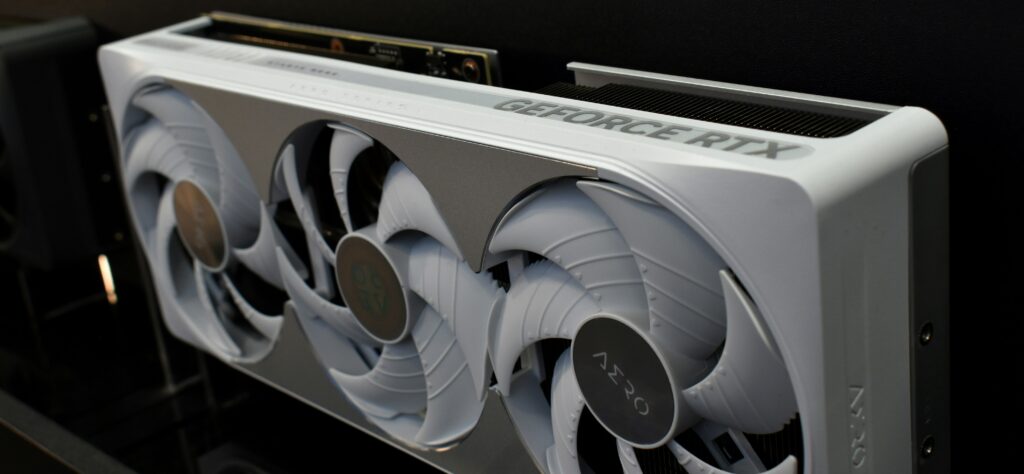
As the tech industry continues its relentless march forward, the whispers surrounding NVIDIA’s forthcoming **NVIDIA RTX 50 Series** have grown into a roar of excitement. Following the success of the Ada Lovelace architecture, speculation suggests the next generation, likely based on the Blackwell architecture (initially designed for data centers), will make its way to consumer graphics cards, offering a monumental upgrade for enthusiasts and professionals alike.
The Latest Leaks and Expected Innovations
While NVIDIA has yet to make any official announcements, reliable leakers and industry analysts point towards a late 2024 or early 2025 launch window for the flagship models of the **NVIDIA RTX 50 Series**. Key improvements are anticipated across several fronts. Reports suggest a significant increase in CUDA cores, potentially paired with a wider memory bus (up to 512-bit for the top-tier cards) and faster GDDR7 memory. This combination would drastically boost bandwidth, a critical factor for high-resolution gaming and complex AI workloads.
Furthermore, expect advancements in NVIDIA’s RT Cores and Tensor Cores, enhancing ray tracing performance and AI capabilities, respectively. The shift to a more advanced manufacturing process, likely TSMC’s 3nm or 4N enhanced node, is crucial for achieving better power efficiency and higher clock speeds, allowing these GPUs to deliver more performance per watt than ever before. This aligns with a broader industry trend towards optimizing high-performance computing for sustainable growth.
Impact on Gaming and Professional Workflows
The arrival of the **NVIDIA RTX 50 Series** is set to be a true game-changer for the gaming community. With expected performance uplifts of 50% or more compared to the RTX 40 series, 4K gaming with ray tracing and path tracing will become even more accessible and visually stunning. Technologies like DLSS (Deep Learning Super Sampling) are also likely to see further enhancements, potentially with new AI-powered features that can upscale resolutions and generate frames with even greater fidelity and less latency.
Beyond gaming, these next-gen GPUs will have a profound impact on professional workflows. Content creators, 3D artists, engineers, and AI researchers will benefit from significantly faster rendering times, more complex simulations, and quicker training of AI models. The increase in VRAM and computational power will unlock new possibilities for local AI applications, allowing users to run more sophisticated large language models and generative AI tools directly on their PCs without relying as heavily on cloud infrastructure. This democratizes access to cutting-edge AI, pushing the boundaries of what individual creators and small businesses can achieve.
Expert Predictions and the Future Landscape
Industry experts predict that the **NVIDIA RTX 50 Series** will solidify NVIDIA’s dominant position in the high-end GPU market, further pushing the boundaries of graphical realism and computational power. Analysts at Tom’s Hardware and similar publications often highlight the competitive landscape, noting that AMD will also be introducing its next-gen RDNA 4/5 architecture. However, NVIDIA’s long-standing leadership in specific segments like AI and ray tracing, coupled with its robust software ecosystem (CUDA, OptiX, DLSS), gives it a strong edge.
We can anticipate a continued focus on power efficiency and potentially new cooling solutions to manage the increased thermal output of these powerful components. Moreover, the integration of new dedicated hardware accelerators for specific AI tasks might be a key differentiator. The future of desktop computing, especially in creative and scientific fields, is undoubtedly tied to the innovations brought by these next-gen GPUs.
In conclusion, the prospective **NVIDIA RTX 50 Series** represents more than just an incremental upgrade; it signifies a pivotal moment in hardware evolution. With promises of unparalleled performance, advanced AI capabilities, and significant efficiency gains, it stands ready to reshape our expectations for both gaming and professional productivity. The next chapter in high-performance graphics is just around the corner, and it looks incredibly exciting.