
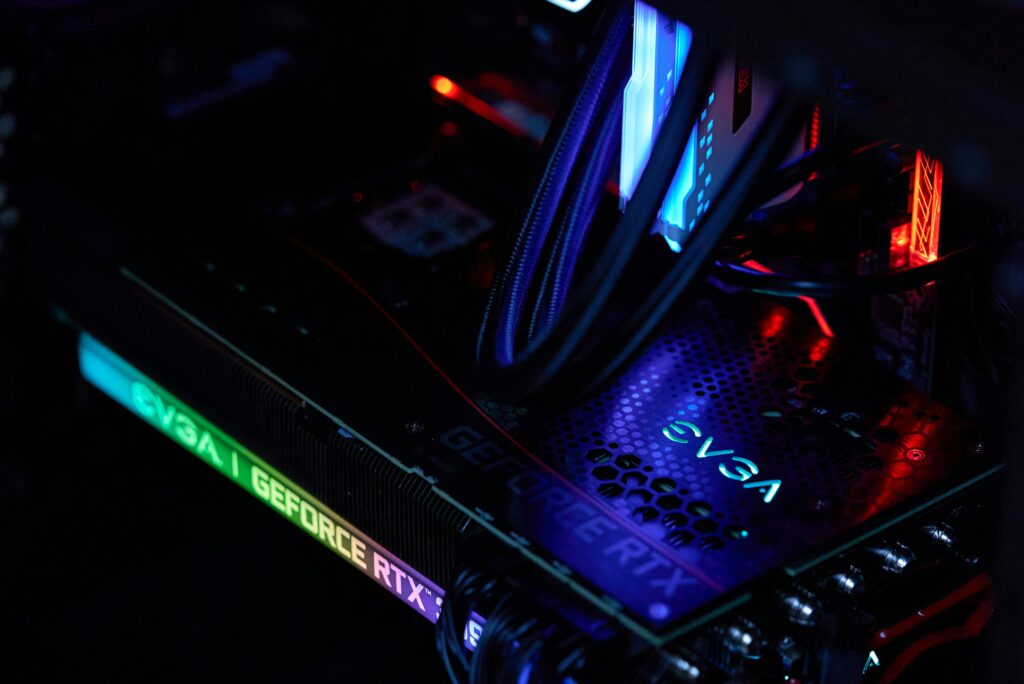
NVIDIA, a dominant force in the graphics processing unit (GPU) market, is reportedly on the cusp of unveiling its next-generation architecture, widely rumored to be code-named ‘Blackwell’ and expected to power the RTX 5000 series. While official details remain under wraps, industry insiders and credible tech leaks suggest an announcement could arrive in late 2024, with product availability stretching into early 2025. This new generation is poised to succeed the highly successful Ada Lovelace architecture, promising significant performance gains and enhanced capabilities across the board.
Key reports and data analyses from firms like Jon Peddie Research indicate that each NVIDIA generation typically brings a 50-100% performance improvement in ray tracing and rasterization. For the Blackwell architecture, leaked specifications hint at a substantial increase in core counts, memory bandwidth, and the introduction of advanced Tensor Cores for AI acceleration. Furthermore, expect a refined manufacturing process, likely a 3nm node, which will allow for greater transistor density and improved power efficiency. This technological leap is not just about raw power; it’s about optimizing how data is processed and rendered, making every frame count and every computation faster.
The impact of this next-gen GPU on the industry will be profound. For gamers, it means an unprecedented level of visual fidelity, smoother frame rates even at 4K and 8K resolutions, and more immersive experiences with complex ray-traced lighting. Virtual reality (VR) and augmented reality (AR) applications will also benefit immensely, enabling higher refresh rates and more realistic environments, reducing latency and enhancing user comfort. Beyond entertainment, creative professionals in fields like 3D rendering, video editing, and architectural visualization will experience drastically reduced render times, accelerating their workflows and enabling more complex projects. Even scientific simulations and data analysis, which increasingly rely on GPU acceleration, will see a significant boost in processing capabilities.
Experts like those at TechCrunch anticipate that the Blackwell architecture will not only solidify NVIDIA’s market leadership but also push competitors like AMD and Intel to innovate faster. The integration of more powerful AI cores suggests a future where GPUs are not just for graphics but are central to local AI processing, enabling smarter applications and services directly on the user’s device. This could drive a new wave of innovation in personal computing, making intelligent systems more accessible and pervasive. We might see an evolution in how games are developed, with developers leveraging the new hardware to create dynamic, AI-driven worlds that respond in real-time to player actions, blurring the lines between reality and simulation.
In conclusion, NVIDIA’s next-gen GPU is shaping up to be more than just an incremental upgrade; it’s an architectural revolution. From delivering unparalleled gaming experiences to accelerating professional workflows and pioneering advancements in AI, the Blackwell generation promises to be a cornerstone of future technological progress. Its arrival will undoubtedly spark renewed excitement in the hardware market, pushing the boundaries of what’s possible and paving the way for innovations we can only begin to imagine.
For more insights into how cutting-edge hardware is transforming business operations and enhancing productivity, read our article on Optimizing Workflow with High-Performance Hardware.
Stay updated with the latest developments in GPU technology and more by following leading tech news outlets. For deeper technical analysis on new product launches, consider sources like The Verge’s Tech Section.